
Buildings.Fluid.AirFilters.BaseClasses
Package with base classes for Buildings.Fluid.AirFilters
Information
This package contains base classes that are used to construct the models in Buildings.Fluid.AirFilters.
Extends from Modelica.Icons.BasesPackage (Icon for packages containing base classes).
Package Content
| Name | Description |
|---|---|
 FiltrationEfficiency FiltrationEfficiency
|
Filtration efficiencies for capturing each contaminant |
 FlowCoefficientCorrection FlowCoefficientCorrection
|
Flow coefficient correction factor due to the contaminant accumulation |
 MassAccumulation MassAccumulation
|
Mass of the contaminants capatured by the filter |
 MassTransfer MassTransfer
|
Component that sets the trace substance at the filter outlet |
 PressureDropWithVaryingFlowCoefficient PressureDropWithVaryingFlowCoefficient
|
Flow resistance with a varying flow coefficient |
 Validation Validation
|
Collection of models that illustrate model use and test models |
 Buildings.Fluid.AirFilters.BaseClasses.FiltrationEfficiency
Filtration efficiencies for capturing each contaminant
Information
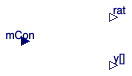
This model calculates the filtration efficiency, eps, using cubic Hermite spline interpolation of the filter dataset (see Buildings.Fluid.AirFilters.Data.Characteristics.FiltrationEfficiencyParameters) with respect to the input rat.
The rat is the relative mass of the contaminant that is captured by the filter, and is calculated by
rat = mCon/mCon_max,
where mCon is the mass of all the captured contaminants, and mCon_max is the maximum mass of the contaminants that can be captured.
Extends from Modelica.Blocks.Icons.Block (Basic graphical layout of input/output block).
Parameters
| Type | Name | Default | Description |
|---|---|---|---|
| Mass | mCon_max | Maximum mass of the contaminant that can be captured by the filter [kg] | |
| String | namCon[:] | Name of trace substance | |
| FiltrationEfficiencyParameters | filEffPar[nConSub] | Filtration efficiency versus relative mass of the contaminant |
Connectors
| Type | Name | Description |
|---|---|---|
| input RealInput | mCon | Mass of the contaminant captured by the filter [kg] |
| output RealOutput | y[nConSub] | Filtration efficiency of each contaminant [1] |
| output RealOutput | rat | Relative mass of the contaminant captured by the filter, which is the total captured contaminant mass divided by the filter's maximum contaminant capacity [1] |
Modelica definition
 Buildings.Fluid.AirFilters.BaseClasses.FlowCoefficientCorrection
Flow coefficient correction factor due to the contaminant accumulation

Information
This model calculates the flow coefficient of the filter by
dpCor = brat,
where b is the flow resistance coefficient, which must be greater than 1,
rat is the relative mass of the contaminant that is captured by the filter
as described in
Buildings.Fluid.AirFilters.BaseClasses.FiltrationEfficiency.
References
Qiang Li ta al., (2022). Experimental study on the synthetic dust loading characteristics of air filters. Separation and Purification Technology 284 (2022), 120209.
Extends from Modelica.Blocks.Icons.Block (Basic graphical layout of input/output block).
Parameters
| Type | Name | Default | Description |
|---|---|---|---|
| Real | b | 2.0 | Resistance coefficient |
Connectors
| Type | Name | Description |
|---|---|---|
| input RealInput | rat | Relative mass of the contaminant captured by the filter. It's the total captured contaminant mass divided by the filter's maximum contaminant capacity [1] |
| output RealOutput | y | Flow coefficient correction [1] |
Modelica definition
 Buildings.Fluid.AirFilters.BaseClasses.MassAccumulation
Mass of the contaminants capatured by the filter
Information
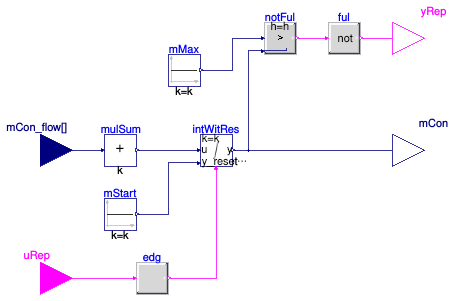
This model mimics the process for a filter to capture the contaminants.
The mass of the contaminants, mCon, increases over time.
However, when the input signal uRep changes from false
to true, mCon is reset to mCon_start.
Extends from Modelica.Blocks.Icons.Block (Basic graphical layout of input/output block).
Parameters
| Type | Name | Default | Description |
|---|---|---|---|
| Integer | nConSub | 1 | Total number of contaminant substance types |
| Mass | mCon_max | Maximum mass of the contaminant that can be captured by the filter [kg] | |
| Mass | mCon_start | Initial contaminant mass of the filter after replacement [kg] |
Connectors
| Type | Name | Description |
|---|---|---|
| input RealInput | mCon_flow[nConSub] | Contaminant mass flow rate [kg/s] |
| input BooleanInput | uRep | Switch to true to replace the filter and reset the accumulation |
| output BooleanOutput | yRep | True if the filter is full and should be replaced |
| output RealOutput | mCon | Mass of the contaminant captured by the filter [kg] |
Modelica definition
 Buildings.Fluid.AirFilters.BaseClasses.MassTransfer
Component that sets the trace substance at the filter outlet

Information
This model sets the trace substance
of the medium that leaves port_b by
port_b.C_outflow = inStream(port_a.C_outflow) - eps * C_inflow;
where eps is an input mass transfer efficiency and
C_inflow is an input trace substance rate.
This model has no pressure drop.
Extends from Buildings.Fluid.Interfaces.PartialTwoPort (Partial component with two ports).
Parameters
| Type | Name | Default | Description |
|---|---|---|---|
| replaceable package Medium | PartialMedium | Medium in the component | |
| String | namCon[:] | Name of contaminant substance | |
| Assumptions | |||
| Boolean | allowFlowReversal | true | = false to simplify equations, assuming, but not enforcing, no flow reversal |
Connectors
| Type | Name | Description |
|---|---|---|
| FluidPort_a | port_a | Fluid connector a (positive design flow direction is from port_a to port_b) |
| FluidPort_b | port_b | Fluid connector b (positive design flow direction is from port_a to port_b) |
| input RealInput | eps[nConSub] | Filtration efficiency of each contaminant [1] |
| output RealOutput | mCon_flow[nConSub] | Contaminant mass flow rate [kg/s] |
Modelica definition
 Buildings.Fluid.AirFilters.BaseClasses.PressureDropWithVaryingFlowCoefficient
Flow resistance with a varying flow coefficient

Information
Model of a flow resistance with a varying flow coefficient.
This block is implemented based on Buildings.Fluid.FixedResistances.PressureDrop and inherits most of its configuration. However, its mass flow rate is calculated differently by using
m_flow / √dp = m_flow_nominal / (√dp_nominal*dpCor),
where dpCor is a correction factor of the flow coefficient.
Therefore, if dpCor=1.2,
at the nominal mass flow rate m_flow_nominal,
there will be 20% more pressure drop
than dp_nominal.
Extends from Buildings.Airflow.Multizone.BaseClasses.PartialOneWayFlowElement (Partial model for flow resistance with one-way flow), Buildings.Airflow.Multizone.BaseClasses.PowerLawResistanceParameters (Power law resistance parameters).
Parameters
| Type | Name | Default | Description |
|---|---|---|---|
| replaceable package Medium | PartialMedium | Medium in the component | |
| MassFlowRate | m_flow | if Modelica.Math.isEqual(m, ... | Mass flow rate from port_a to port_b (m_flow > 0 is design flow direction) [kg/s] |
| Real | m | 0.85 | Flow exponent, m=0.5 for turbulent, m=1 for laminar |
| Nominal condition | |||
| MassFlowRate | m_flow_nominal | Nominal mass flow rate [kg/s] | |
| PressureDifference | dp_nominal | Pressure difference of clean filter at m_flow_nominal [Pa] | |
| Advanced | |||
| MassFlowRate | m_flow_small | 1E-4*abs(m_flow_nominal) | Small mass flow rate for regularization of zero flow [kg/s] |
| Boolean | forceErrorControlOnFlow | true | Flag to force error control on m_flow. Set to true if interested in flow rate |
| Boolean | useDefaultProperties | true | Set to false to use density and viscosity based on actual medium state, rather than using default values |
| PressureDifference | dp_turbulent | 0.1 | Pressure difference where laminar and turbulent flow relation coincide. Recommended = 0.1 [Pa] |
| Diagnostics | |||
| Boolean | show_T | false | = true, if actual temperature at port is computed |
Connectors
| Type | Name | Description |
|---|---|---|
| FluidPort_a | port_a | Fluid connector a (positive design flow direction is from port_a to port_b) |
| FluidPort_b | port_b | Fluid connector b (positive design flow direction is from port_a to port_b) |
| input RealInput | dpCor | Flow coefficient correction factor [1] |